
Leading FMCG companies have announced a price cut on their products, including soaps, shampoo, baby diapers, toothpaste, razors, and after-shave lotions, effective from September 22 to extend the GST rate cut benefits to consumers. Firms such as Procter & Gamble, Emami and HUL have come up with new price lists which have been communicated to their respective distributors and consumers through their respective websites.

Since items in the 12% category account for only about 5% of total GST, the additional boost to consumption may not be significant, points out M Govinda Rao.

The July-September quarter (Q2) performance of consumer electricals and durables major Havells India in 2025-26 (FY26) was broadly in line with Street estimates. While the top line was supported by robust growth in the wire and cable, switchgear, and lighting segments, the consumer durables segment restricted overall gains.

Following Axis Max Life Insurance's second-quarter results for 2025-26, Sumit Madan, managing director and chief executive officer of the company, speaks to Aathira Varier and Subrata Panda/Business Standard about growth aspirations, strategies to offset the impact of the input tax credit (ITC) withdrawal, reverse merger plans, and more.

The bumper rise is due to the rising demand for the drug and patients' gradual shift towards its higher dosage.

These changes certainly bring India's GST a lot closer to what an ideal GST would look like, points out Karan Bhasin.

India's mergers and acquisitions (M&A) activity cooled in the second quarter of 2025-26 (Q2FY26), with deal value falling to $26.26 billion from $29.04 billion a year ago, according to Bloomberg data.

The life and non-life insurance industries are hopeful of a reduction in the goods and services tax (GST) on health and life insurance premiums, after Prime Minister Narendra Modi, in his speech on Friday, announced GST relaxations aimed at providing relief to ordinary citizens, farmers, the middle class, and the small and medium enterprises (MSME) sector.

Both the life and non-life insurance segment posted over 20 per cent premium growth in November for the first time in this financial year (FY26), supported by the reduction in goods and services tax (GST) on premiums from 18 per cent to zero and a favourable base effect.

The best course for the government at this time would be to tighten the seat belt a little more, without compromising on its investments in creating better infrastructure and giving a push to privatisation, points out A K Bhattacharya.

New Delhi will substantially reduce tariffs on industrial and agricultural goods while continuing to protect sensitive sectors. Tariffs on some agricultural products that are not traditionally considered sensitive will be brought down to zero, while in the case of relatively sensitive items, duties will be reduced in a graded manner and quotas will be imposed.

The change in the government's engagement with the economy's need for reforms is more nuanced than how analysts have so far perceived it, points out A K Bhattacharya.

Amazon India unveiled a dedicated marketplace section highlighting products with reduced tax burdens as the goods and services tax (GST) restructuring took effect on September 22, positioning the ecommerce giant to capitalise on lower consumer prices across electronics, appliances, and other categories. Its rival Flipkart, too, has rolled out its own GST-focused storefront, the GST Bachat Utsav, aimed at helping shoppers maximise benefits from the new tax rates across multiple categories.

Indian consumers are entering the festive season with renewed confidence and financial optimism, outpacing global benchmarks, according to Deloitte India's latest Consumer Signals: India Chapter. "With inflationary pressures easing and the recent Goods and Services Tax (GST) revisions enhancing purchasing power and festive cheer among consumers, this brings a new wave of consumption.

'In case a particular industry has not passed on the benefits and if we receive complaints, we will take up the matter with the industry body concerned.'

Simplifying GST rates, removing exemptions, easing disputes, and speeding up refunds can boost investment in India and offer the best reply to Trump's tariffs, observes V S Krishnan, former member, Central Board of Indirect Taxes and Customs.

The Reserve Bank on Wednesday revised upward its growth estimates for the current fiscal year to 6.8 per cent and lowered its inflation projection to 2.6 per cent based on an above-normal monsoon and the rationalisation of GST rates.

Opposition-ruled states warn of steep annual losses; Centre assures higher consumption will offset revenue hit.

Foreign portfolio investors sold stocks worth Rs 1.42 trillion in 2025, with their sales hitting Rs 12,257 crore in the first four trading days of September.

GST, net of refunds, now yields close to 20 trillion to both the Centre's and states' exchequer.

Gross GST collection increased 7.5 per cent to about Rs 1.96 lakh crore in July on higher domestic revenues and taxes from imports. Gross Goods and Services Tax (GST) mop-up was Rs 1.82 lakh crore in July 2024. Last month, the collection was Rs 1.84 lakh crore.

The small sports utility vehicle (SUV) segment - comprising models less than 4 metres in length - could witness the "maximum" growth among all categories in the coming months following the recent goods and services tax (GST) rate rationalisation, Tarun Garg, chief operating officer of Hyundai Motor India (HMIL), said.

While GST on ICE vehicles was brought down significantly, for electric cars it remained at 5 per cent.

Think again. Not filing could cost you. Here's who must file, who should, and why it matters. What's more, the deadline to file your ITR has been extended till September 15, 2025
Noting that recent uncertainties created by global tariffs have not impacted the Indian economy severely, Anuradha Thakur, secretary, Department of Economic Affairs, said the central government is hopeful that the recent goods and services tax (GST) rationalisation will ignite the much needed animal spirits in the financial sector.

Finance Minister Nirmala Sitharaman on Thursday said there are no changes in tax rates for direct and indirect taxes, including import duties. She also said the number of tax filers has swollen 2.4 times and the direct tax collection has trebled since 2014.

India's top cement producers delivered a solid July-September quarter (Q2) in 2025-26 (FY26), lifted by firmer prices, higher sales volumes, and a favourable base. Seasonal weakness and maintenance outages did dent sequential performance, but the overall picture remained positive - and the road ahead looks steady.

Hindustan Unilever Ltd's (HUL's) second quarter 2025-26 (Q2FY26) consolidated revenue rose 2 per cent to Rs 16,250 crore, with low or flat volume growth. Demand remained stable but goods and services tax (GST) transition and prolonged monsoon hurt offtake.

With lower GST rates taking effect, fast-moving consumer goods players face challenges in setting reduced prices for their products in round figures, but expect the magical price points to be restored within two months.

'Amazon, Meta, Google, Microsoft have large operations in India and rely on smooth trade and data flows.' 'Restrictions could raise their costs, limit AI chip exports, and complicate their India strategies.'

Amid US-China trade tensions and economic vulnerabilities, India must seize the 'China +1' opportunity, deepen reforms, secure FTAs, and globalise its firms for long-term growth, suggests Ajay Shah.

States will remain "net gainers" of the proposed GST rate rationalisation exercise with their GST revenues, including devolution, estimated to be over Rs 14.10 lakh crore this fiscal, according to an SBI Research report released on Tuesday. It said that, as was evidenced in the earlier exercise of GST rate rationalisation in 2018 and 2019, an immediate reduction in rates can cause a short-term dip of around 3-4 per cent in month-on-month collections (roughly Rs 5,000 crore, or an annualised Rs 60,000 crore), revenues typically rebound with sustained growth of 5-6 per cent per month.

UBS has turned bullish on emerging markets (EM), including India, as it finds benign macro trends, positive momentum in earnings revisions, and resilient EM currencies helping these economies sustain higher valuations and attracting flows. Among regions, it has upgraded Mainland China to 'attractive' and China Tech to 'most attractive', while downgrading Philippines to 'neutral'.
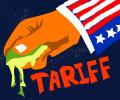
India needs to come together to deal with the 50 per cent punitive US tariffs on Indian products and stand up to any kind of bullying, Maruti Suzuki India chairman R C Bhargava said on Thursday. "It is our duty as Indians to do our very best to promote and maintain our dignity and respect and not give in to any kind of bullying in this matter... the nation has to stand united," Bhargava said at the company's 44th Annaul General Meeting in New Delhi.

'States should be compensated for the revenue loss for at least five years or beyond till the revenue stabilises.'

Trent reported decent margins in the second quarter (July-September) of 2025-26 (Q2FY26) but growth moderated. Same store growth was low single-digits. Trent's revenue growth decelerated in Q2FY26 at 17 per cent year-on-year (Y-o-Y) while area additions were offset by decline in revenue per square foot (sq ft).

As lower GST rates take effect on Monday, sales of air-conditioners, TV sets surged dramatically with buyers rushing to grab cheaper deals offered by retailers at the beginning of the Navratra festival.

Recent developments - proposed changes to the goods and services tax (GST) rates and S&P Global Ratings' upgrade of India's long-term sovereign credit rating to BBB, with a stable outlook, - may not be enough to bring foreign investors back to Indian markets in a rush, feel analysts.

Maharashtra has topped the list of states with the most favourable ecosystem for the growth of Farmer Producer Organisations (FPOs), replacing Madhya Pradesh, which has slipped to second place, according to the latest Ease of Doing Business for FPOs (EoDBF) ranking.

The 2023-2024 figures showed that the size of the industry, excluding those having an annual turnover of Rs 20 crore, could be Rs 30,652 crore, assuming no tax evasion.
